How to Set Up Appraisal Cycle in Zoho People[Best Practices]
Discover how to set up the appraisal cycle in Zoho People the right way. Learn step-by-step on how to create an appraisal cycle, best practices, and expert tips to avoid common pitfalls for a fair, efficient, and impactful performance review process.

Performance reviews are never easy. As an HR leader, you’ve probably seen both ends of the spectrum: the review that sparks motivation and growth, and the one that leaves employees frustrated, disengaged, and ready to polish their résumes.
The difference usually lies in how structured and transparent the appraisal cycle is. When performance reviews are consistent, fair, and aligned with business goals, employees trust the process, and managers feel equipped to guide their teams.
Without proper appraisal cycle structure, things quickly spiral into confusion, bias, and resentment.
That’s where Zoho People comes in.
If you’re using Zoho People, you already know it’s more than just an HRMS (Human Resource Management System). Zoho People is a all-in-one HRMS solution developed to make HR smarter, more efficient, and most importantly, more human.
And one of its standout features? The appraisal cycle.
Needless to say, the appraisal cycle isn’t just about ratings; it’s about fostering a culture of continuous learning, recognition, and alignment with the company’s vision.
When done right, it creates workplaces where employees feel valued, managers feel confident, and organizations thrive.
But here’s the catch: setting up appraisal cycles in Zoho People isn’t a “click and go” task. It requires careful planning, thoughtful configuration, and ongoing management to ensure the process actually drives performance instead of becoming another bureaucratic checkbox.
This guide will walk you through everything:
- How Appraisal Cycles Work in Zoho People
- Why the Appraisal Cycle Matters Even in 2025
- Step-by-Step Process to set them up, and best practices you can use to make them a success.
- Common mistakes to avoid, how to leverage advanced features in Zoho People to take the appraisal cycle to the next level, and what seasoned HR leaders do differently.
By the end of reading this post, you’ll not only know how to configure Zoho People, but also how to build an appraisal cycle that actually works for both HR and employees.
Why Appraisal Cycles Matter (Yes, Even in 2025)
Before we jump into the details, let’s take a step back. Why bother with appraisal cycles at all?
Think about it: growth without feedback is like throwing darts in the dark. Sure, you might hit the bullseye once in a while… but mostly, you’re just flinging sharp objects and hoping for the best.
When done right, appraisals can help you:
- Recognize contributions so employees feel appreciated.
- Spot skill gaps before they turn into bigger performance issues.
- Set clear expectations that link individual goals to company goals.
- Build accountability, making growth a team effort rather than a solo mission.
This is where Zoho People really stands out. Forget clunky Excel sheets or awkward once-a-year chats. Zoho People lets you:
- Automate appraisal cycles - no more “Oops, I forgot to send the forms.”
- Customize evaluations - from rating scales to 360-degree reviews and self-appraisals.
- Generate insights fast - reports and analytics ready without a week of HR scrambling.
In short, it takes performance reviews from a painful chore to a process that actually adds value.
What is mean by Appraisal Cycle in Zoho People?
Before diving into the how-to, let’s get clear on what.
In Zoho People, an appraisal cycle is a structured review period where employee performance is evaluated based on pre-defined criteria. It could be annual, semi-annual, or even quarterly, depending on your company’s rhythm.
In short, the appraisal cycle is the main thing that powers performance management in Zoho People.
An appraisal cycle usually answers three big questions:
- When will reviews happen?
- Who is reviewing whom?
- How will performance be measured?
Zoho People makes this easy because you can customize appraisal cycles down to the smallest detail.
Want to run quarterly reviews for sales but annual ones for engineering? Done.
Want to use a 5-star scale for teamwork but a numeric score for productivity? Also doable.
The brilliance here is flexibility. HR leaders aren’t forced into a rigid “one-size-fits-all” process. Instead, Zoho People adapts to the company’s culture and growth stage.
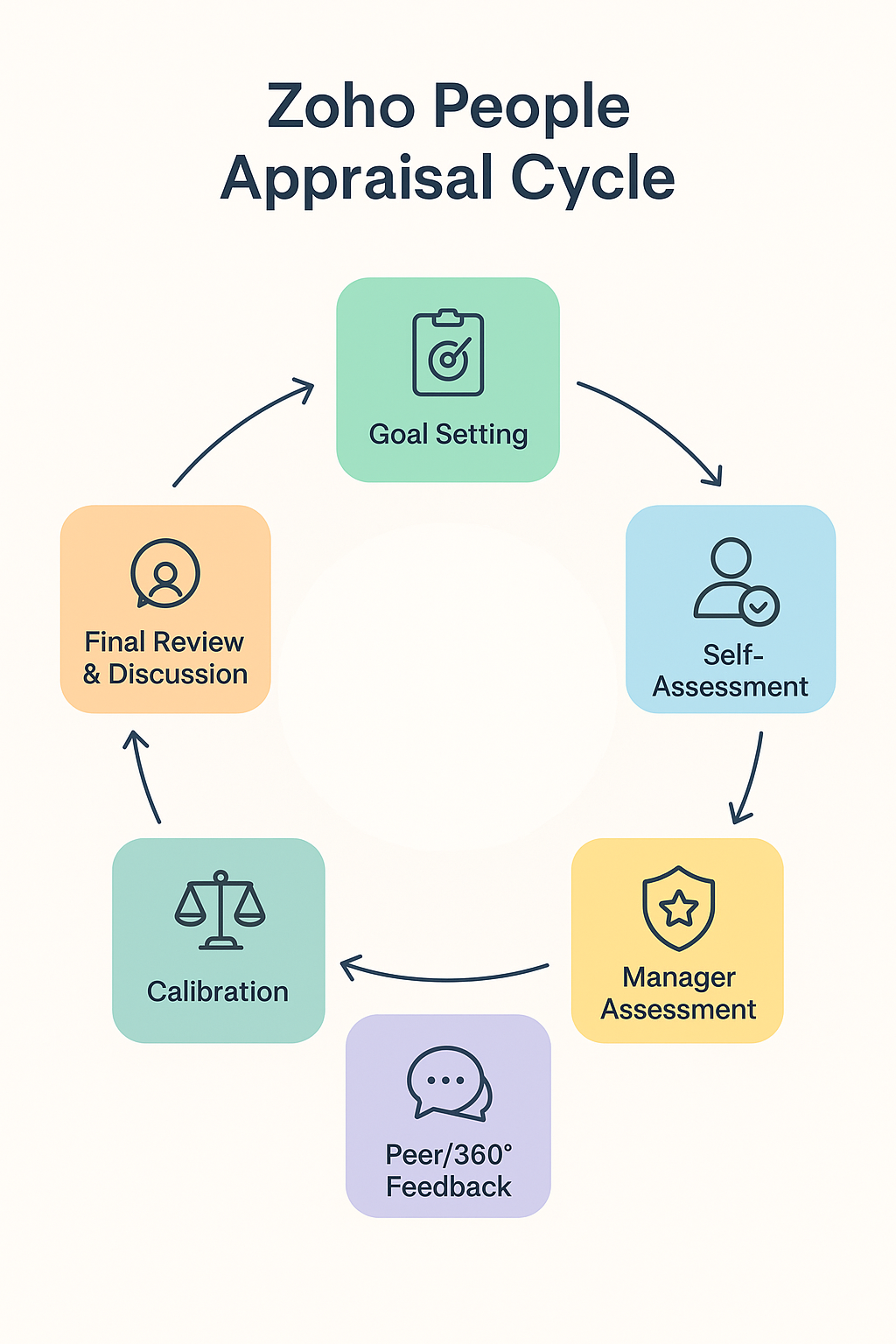
Here’s what makes up an appraisal cycle in Zoho People:
- Cycle Period: The timeframe for which performance is measured (annual, biannual, quarterly, etc.).
- Participants: Employees, reviewers, and approvers involved in the process.
- Competencies & Goals: The parameters against which employees are assessed.
- Rating Scales: How performance is scored (numeric, descriptive, weighted).
- Feedback Mechanisms: 360-degree reviews, self-assessments, peer input, and manager evaluations.
- Workflow & Automation: Notifications, reminders, and approval stages.
Think of it as building a stage. The more thoughtfully you design it, the better the performance (and outcomes) will be.
Related Content: Expert Tips to Avoid 10 Silent Killers of Zoho People Implementation
Prepping for Your Appraisal Cycle in Zoho People
The success of an appraisal cycle starts before you click “Create Cycle” in Zoho People.
1. Gather performance data in advance
Start tracking performance early. Encourage managers to record wins, challenges, and progress throughout the year. Zoho People integrates with daily check-ins, attendance, and goal tracking. Use that data to make reviews accurate and meaningful.
Recommended Content To Read: 👉 How to Automate Your Employee Onboarding in Zoho People
2. Align with business objectives
Define the purpose of this appraisal cycle. Are you deciding bonuses, identifying training needs, or aligning employees with new goals? Clear objectives make the appraisal a useful tool instead of a formality.
3. Set clear expectations with employees
Be transparent. Share when appraisals will happen, the criteria for evaluation, and how the results will be used. So employees stay fully informed.
Step-by-Step to Setting Up Appraisal Cycles in Zoho People
Let me walk through the process for creating an appraisal cycle in Zoho People.
Step 1: Develop a Comprehensive Appraisal Cycle Plan
Here’s a truth bomb: the technology is only as good as the strategy behind it. Before you even touch Zoho People’s appraisal settings, you need to answer a few big-picture questions:
- What’s the purpose of your appraisal cycle?
- Is it purely performance evaluation?
- Is it tied to compensation decisions?
- Or is it more developmental, focusing on coaching and growth?
- How often will you run appraisal cycles?
- Annual reviews are common, but many organizations are shifting toward bi-annual or even quarterly cycles.
- The shorter the cycle, the more agile your feedback loop.
- Who will be involved?
- Just the employee and their manager?
- Or do you want a 360-degree feedback system that includes peers, subordinates, and even self-assessments?
- What will you measure?
- KPIs and hard metrics?
- Behavioral competencies?
- Alignment to company values?
Start simple. If this is your first time setting up appraisal cycles in Zoho People, don’t try to boil the ocean. Maybe begin with annual reviews using manager + self-appraisal, then expand once everyone’s comfortable.
💡 Pro tip: Don’t make appraisal cycles too long. A yearly review might feel efficient, but so much can change in a year. Bi-annual or even quarterly check-ins make the process less intimidating and more meaningful.
Step 2: Select the Most Suitable Appraisal Techniques
Choosing the right appraisal method is crucial for effective performance management.
Zoho People offers several options to consider:
- Self-Appraisal: Employees reflect on their own performance. This promotes self-awareness, but it should be balanced with additional perspectives.
- Manager Review: The traditional approach where managers evaluate their team members’ work.
- Peer Review: Colleagues provide feedback. This can offer valuable insights, though it is important to be mindful of potential biases.
- Multi-Rater/360° Feedback: A comprehensive method that includes feedback from employees, peers, managers, and sometimes external stakeholders.
The most appropriate method depends on your company culture and goals. For teams that prioritize collaboration, peer feedback can be particularly valuable. In more conventional settings, using manager feedback in conjunction with employee self-assessments may be sufficient.
💡Consider the purpose of your appraisal process: Do you want to encourage employees to reflect on their work, foster collaboration among team members, or focus primarily on achieving measurable outcomes?
Use your objectives as a guiding principle, and tailor the appraisal approach to align with them.
Step 3: Configure Appraisal Templates
Appraisal Templates define the questions and criteria used in employee reviews. Without a structured template, feedback may be vague and unhelpful, such as “Keep up the good work,” which provides no actionable guidance for improvement.
In Zoho People, you can:
- Add competencies, such as leadership, problem-solving, and communication.
- Include Goals/Key Result Areas (KRAs) aligned with the employee’s role.
- Create custom questions, including both rating scales and open-ended formats.
Example:
- Rating scale: “On a scale of 1-5, how well does the employee meet deadlines?”
- Open-ended: “What is one area where this employee could grow over the next cycle?”
💡 Appraisal Templates should be tailored to specific roles. For instance, a developer’s performance should not be evaluated on client interaction if the role does not involve client engagement, ensuring that templates reflect the responsibilities of each role will make feedback more relevant and actionable.
Step 4: Assign Participants and Reviewers for the Appraisal Cycle
An appraisal cycle functions effectively only when the right people are included. In Zoho People, you should:
- Select Participants: Choose which employees will be part of the cycle. Options include all employees, specific departments, or individually selected team members.
- Assign Reviewers: Typically, reviewers are managers; however, peers can also be assigned if your settings allow it.
Careful planning at this stage prevents issues later. Omitting key team members can disrupt the process and cause delays.
Important: Verify all reviewer assignments. If a manager has left the company or moved to a different team, Zoho will not automatically reassign their responsibilities. You must update reviewer assignments manually to ensure accountability and a smooth appraisal process.
Step 5: Set Weights and Ratings
Not all evaluation criteria carry the same weight. For example, your organization may value teamwork more than punctuality. Zoho People allows you to assign weights to competencies, goals, and other performance factors, ensuring that the final appraisal score reflects what matters most to your company.
Example of Weighted Criteria:
- Teamwork: 40%
- Technical Skills: 30%
- Punctuality: 10%
- Innovation: 20%
You can also customize rating scales to suit your needs. Choose a numeric scale, such as 1–5 or 1–10, or descriptive levels like “Needs Improvement,” “Meets Expectations,” and “Exceeds Expectations.” This flexibility allows you to align appraisals with your company’s priorities and evaluation standards.
💡 Avoid making the rating scale overly complex. If it takes a manager 15 minutes to determine whether someone is a 7 or an 8, the scale is too detailed.
Step 6: Launch the Cycle
This is the exciting part. Once everything is configured, hit Launch and go live. Participants will be notified automatically.
However, don’t rely solely on system notifications. Send a company-wide email or chat message explaining:
- What’s the real purpose of the appraisal?
- What is the timeline?
- How employees should prepare?
Transparency sets the tone. When people understand the why and the how, they will engage with the process rather than dread it.
💡Host a short orientation call or share a video explaining how the appraisal cycle works. This ensures everyone is on the same page.
Step 7: Monitor and Manage the Appraisal Cycle
Starting the appraisal cycle is only the beginning; it's the first step in a process that requires ongoing monitoring of progress.
In Zoho People, you can:
- Track which reviews are completed and which are pending.
- Send reminders to managers or employees who haven’t submitted feedback.
- Step in to resolve bottlenecks (like if a reviewer is on vacation and everything’s stalled).
Step 8: Close, Review and Interpret Appraisal Cycle Outcomes
Once the appraisal cycle is finished, you'll finalize it in Zoho People. However, don't simply archive it, as this is where the valuable insights are found.
Zoho People generates reports that show:
- Individual performance trends
- Team/department-level insights
- Who’s ready for promotions or needs improvement in which area?
This is the data you can use to shape training programs, career paths, and even hiring decisions. It’s not about judgment; it’s about making smarter choices.
💡 Schedule a follow-up meeting with managers after each cycle. Talk through the data, compare notes, and decide how you’ll act on the findings.
In a nutshell, Performance reviews shouldn’t end with a score. Use the outcomes to build personalized training and development plans within Zoho People.
Key takeaways:
- Do the prep work before setup.
- Use Zoho People’s step-by-step cycle builder.
- Actively manage cycles post-launch.
- Avoid vague goals and over complicated scales.
- Keep the process human-centered.
Setting up appraisal cycles in Zoho People is powerful, but it can feel overwhelming without expert guidance. Why not skip the trial-and-error?
Reach out to YAALI, a reputable Zoho Partner, to explore how we can customize Zoho People for your organization.
Now let’s explore the best practices HR teams can adopt to make the most of Zoho People’s appraisal cycle setup.
Best Practices for Setting Up Zoho People Appraisal Cycles
Starting the appraisal process is one thing, but executing it successfully is quite another.
Here are the best practices I’ve seen work across companies.
Below are the most important steps and strategies HR teams should follow to ensure their appraisal cycles in Zoho People deliver real impact.
1. Start with Crystal-Clear Objectives
Imagine going on a road trip without a destination in mind. You’d drive aimlessly, wasting time and fuel. The same goes for appraisals: without clear objectives, they become mechanical and uninspiring.
Before you even log in to Zoho People, ask:
- Are we evaluating performance to reward, to develop, or both?
- How do appraisals align with our organizational strategy?
- Do we want to prioritize skill development, goal achievement, or cultural alignment?
💡 Pro Tip: Define 2–3 key objectives for each cycle. For instance, one cycle may focus on “goal alignment and productivity,” while another emphasizes “career development and upskilling.”
2. Design Role-Based Appraisal Templates
Not all employees can be evaluated with the same yardstick. A sales executive and a software developer have disparate success metrics.
Zoho People allows you to create role-based appraisal templates that ensure fairness and relevance.
- For sales roles: Focus on revenue targets, client acquisition, and customer satisfaction.
- For developers: Highlight code quality, innovation, and collaboration.
- For HR professionals: Assess employee engagement initiatives, retention rates, and process efficiency.
💡 Pro Tip: Collaborate with department heads to define KRAs and KPIs for each role. This ensures buy-in and ownership across teams.
3. Make Goals SMART and Transparent
We’ve all seen vague goals like “improve performance” or “increase sales.” But what do they actually mean? Without clarity, employees feel lost.
Instead, focus on SMART(Specific, Measurable, Achievable, Relevant, and Time-bound) goals.
- ❌ “Increase sales.”
- ✅ “Achieve a 15% increase in quarterly sales revenue by acquiring five new enterprise clients.”
Zoho People’s goal-setting module allows managers and employees to align objectives seamlessly, creating transparency and accountability.
💡 Pro Tip: Encourage employees to set personal development goals alongside performance goals. This fosters a growth mindset.
4. Leverage Continuous Feedback, Not Just Annual Reviews
Here’s a truth bomb: Annual reviews are outdated. Waiting 12 months to give feedback is like telling a driver they took a wrong turn… after they’ve reached the wrong city.
With Zoho People, you can enable continuous feedback mechanisms:
- Instant recognition for achievements.
- Regular check-ins to monitor progress.
- Peer feedback to encourage collaboration.
💡 Pro Tip: Integrate pulse surveys and one-on-one meetings into the cycle to capture ongoing performance data.
5. Train Managers for Meaningful Conversations
An appraisal cycle process is only as strong as the conversations it sparks. Too often, managers reduce reviews to numbers and ratings. Employees walk away feeling unseen.
Invest in training managers to:
- Provide constructive feedback.
- Recognize achievements genuinely.
- Handle sensitive discussions with empathy.
- Link feedback to career development opportunities.
💡 Pro Tip: Role-play appraisal conversations during manager training sessions. This builds confidence and reduces anxiety.
6. Conduct 360-Degree Feedback for a Balanced View
One person’s perspective can be biased. That’s why Zoho People supports 360-degree feedback, incorporating insights from peers, subordinates, and even clients.
- Managers evaluate performance and goal achievement.
- Peers share collaboration and teamwork insights.
- Self-assessments allow employees to reflect on their contributions.
💡 Pro Tip: Don’t overload employees with too many reviewers. Select 3 to 5 reviewers for balanced and manageable feedback.
7. Automate to Save Time but don’t loose the human part
Spreadsheets and email reminders? That’s a recipe for burnout. Automation is the secret sauce to efficiency.
Zoho People lets you:
- Schedule appraisal cycles in advance.
- Automate notifications and reminders.
- Track completion rates in real-time.
- Generate reports instantly.
💡 Pro Tip: Use Zoho People’s analytics dashboard to identify bottlenecks in the appraisal process and address them proactively.
8. Prioritize Fairness and Transparency
Nothing kills trust faster than an unfair appraisal. Employees talk. If they feel favoritism or bias, morale plummets.
Ensure fairness by:
- Using objective performance metrics.
- Standardizing rating scales across departments.
- Documenting feedback for accountability.
💡 Pro Tip: Share appraisal guidelines with employees before launching the cycle. Transparency eliminates confusion and builds trust.
9. Integrate Learning & Development (L&D) with Appraisals
An appraisal shouldn’t end with a rating; it should spark growth.
Zoho People integrates with L&D initiatives, allowing HR to:
- Recommend training courses based on appraisal outcomes.
- Identify skill gaps across the workforce.
- Track career progression over time.
💡 Pro Tip: Use appraisal data to design personalized learning paths. For instance, if multiple employees struggle with communication skills, roll out a targeted training program.
10. Close the Loop with Actionable Insights
Appraisals lose impact when feedback is given… and forgotten. Closing the loop means turning insights into action.
- Share final reports with employees.
- Set development goals for the next cycle.
- Track progress between cycles.
- Celebrate achievements to reinforce positive behavior.
💡 Pro Tip: Conduct a post-cycle review with HR and managers to evaluate what worked, what didn’t, and how to improve next time.
Need Expert Help Configuring your appraisal cycle in Zoho People efficiently?
Our Zoho Certified developers can help you implement a customized, bias-free, and effective appraisal process within Zoho People tailored to meet your organization's goals.
Actionable Plan for HRs
Feeling inspired but not sure where to start? Here’s a step-by-step action plan:
- Clarify goals: Why are you running appraisals?
- Map stakeholders: Who needs to be involved?
- Design the cycle: Choose goals, feedback methods, and timelines.
- Pilot first: Test with one department before scaling.
- Train managers: Build their feedback and coaching skills.
- Automate smartly: Use Zoho’s reminders, but add human touchpoints.
- Communicate clearly: Keep employees informed at every stage.
- Analyze and act: Turn reports into action plans.
- Iterate: Refine the cycle each year based on feedback.
Common Pitfalls to Avoid when doing Appraisal Cycle in Zoho People
Even experienced HR teams fall into traps when setting up appraisal cycles.
Watch out for these pitfalls:
- Overloading employees with too many forms
Reviews should be thorough, not exhausting. - Not setting clear timelines
Delayed reviews kill momentum. Always enforce deadlines. - Skipping probationary employees entirely
Probation reviews should not be integrated into the cycle, but they shouldn't be overlooked. Instead, conduct a stand-alone probation evaluation process. - Letting ratings drive everything
Ratings matter, but they don’t tell the full story. Balance quantitative scores with qualitative feedback. - One-size-fits-all cycles
Different teams may need different modules. Don’t force the same template across sales, design, and operations. - Neglecting communication: Employees must understand why the cycle exists, not just what they need to do.
- Treating appraisals as judgmental events: Position them as growth conversations, not report cards.
- Failing to close the loop: Appraisals should drive tangible outcomes, such as growth plans, skill-building initiatives, career advancement, and not merely end up as an inactive performance review process.
By avoiding these pitfalls, HR teams can ensure their appraisal cycle truly drives performance and engagement.
Appraisal Cycle: Expert Guidance to Avoid Common Pitfalls
Our Zoho People Specialist helps HR teams implement appraisal cycles tailored to your company's needs, from strategy to automation.
Leveraging Advanced Features in Zoho People for Performance Appraisal Cycle
If your HR team wants to go beyond the basics, Zoho People offers advanced features that can elevate your performance appraisal cycles. These capabilities help ensure fair, data-driven evaluations while supporting employee growth:
- Integration with Zoho Learn: Automatically link appraisal outcomes to personalized training plans, helping employees upskill and stay ahead of the curve.
- Weighting configuration: Assign appropriate weights to goals, competencies, and feedback. For example, 60% goals, 30% competencies, and 10% peer input to reflect your organization’s priorities accurately.
- Compensation integration: Directly link appraisal results to salary revisions, allowing HR to align ratings with increments or bonuses seamlessly.
- Anonymous multi-rater feedback: Keep peer reviews confidential to encourage honest and constructive input.
- Custom reports: Generate tailored reports for HR leadership to track cycle completion rates, performance distribution, and top talent pools effectively.
- Integration with Zoho Analytics: Leverage analytics to identify performance trends across departments, highlight top performers, and flag areas needing improvement.
- Continuous feedback modules: Gather real-time input between appraisal cycles, enabling ongoing development and timely course correction.
- Calibration meetings: Use appraisal data to conduct cross-manager calibration sessions, ensuring consistency and fairness across teams.
🙌🏼 Struggling to configure appraisal cycles the right way?
Collaborate with YAALI to set up appraisal cycles in Zoho People to avoid costly mistakes and ensure smooth adoption across your teams.
Our team of Zoho developers has assisted businesses in implementing Zoho People appraisal cycles that are equitable, adaptable, and regulatory-compliant.
The Future of Appraisal Cycles
The workplace is changing. Remote work, hybrid models, and AI-driven insights are reshaping how performance is measured. In this context, appraisal cycles must evolve too.
Zoho People is already ahead of the curve by enabling:
-Real-time feedback systems (not just end-of-year snapshots).
-Data-driven insights that highlight skill gaps and training needs.
-Appraisals shouldn’t live in isolation. Zoho People allows integration with: Payroll (for performance-linked pay), Zoho Learn (to assign training based on gaps), and Zoho Recruit (to spot future leaders).
Related Content: Top 8 Challenges Solved by Zoho HRMS, Payroll & Accounting Integration
Bear in mind, Performance appraisals don’t live in isolation. Many companies use appraisal insights to make hiring and internal mobility decisions. This is where Zoho Recruit comes into play.
For example, if an appraisal highlights a leadership gap, Zoho Recruit can help you identify and hire the right talent. Similarly, appraisal data can guide skills-based hiring and ensure new employees are aligned with company goals.
👉 Related Read:
1.How to Automate Hiring Process with AI in Zoho Recruit
2.Staffing Agencies Overcome Recruitment Challenges with Zoho Recruit
Wrapping It All Up
Performance appraisals are no longer just HR formalities; they are opportunities to align employees with company goals, motivate performance, and foster growth. With Zoho People, HR teams can establish structured, transparent, and efficient appraisal cycles that connect employee performance directly to organizational objectives.
Keep the appraisal process simple, transparent, and tied to business outcomes. Engage employees actively and avoid letting performance reviews become mere formalities.
The next time you set up an appraisal cycle in Zoho People, ask yourself: Is this process helping employees grow and the company move forward, or is it just another formality?
Whether you lead HR at a startup or a global company, the message is clear: don’t just implement Zoho People’s appraisal cycle; implement it strategically.
Imagine appraisal season without chaos: managers effortlessly reviewing performance, employees receiving actionable feedback, and HR leveraging insights to make informed decisions, all seamlessly coordinated within Zoho People.
With a well-structured appraisal cycle in Zoho People, your HR team can ensure employees feel recognized, managers have clarity, and your organization achieves its strategic goals.
Need expert help configuring appraisal cycles in Zoho People?
Setting up appraisal cycles can be complex, but you don’t have to do it alone.
Our Zoho-certified experts at YAALI can help you configure, customize, and manage appraisal cycles in Zoho People tailored to your company’s needs.
Get Expert Help from YAALI Schedule a Strategy Call
Share this Post if you found this Content Useful😊. Sharing is Caring!
📧 Join over 1000+ Business Owners, Zoho Customers, Consultants, and Zoho Partners who read our content to get the most out of Zoho for their business.
▣ Zoho + Your Business+ Our Expertise = Get Maximum Value out of your Zoho Investment.
Enter Your Email Address Below to receive the Exclusive Content that we only share with those who Subscribe to our Newsletter!


