Why Choose Zoho Creator to Build a Multi-Tenant SaaS Product
Building a SaaS product sounds exciting until complexity slows you down. From multi-tenant architecture to security and scaling, the challenges are real. Discover how Zoho Creator helps you launch faster, reduce costs, and focus on what truly matters, delivering value your customers will pay for.

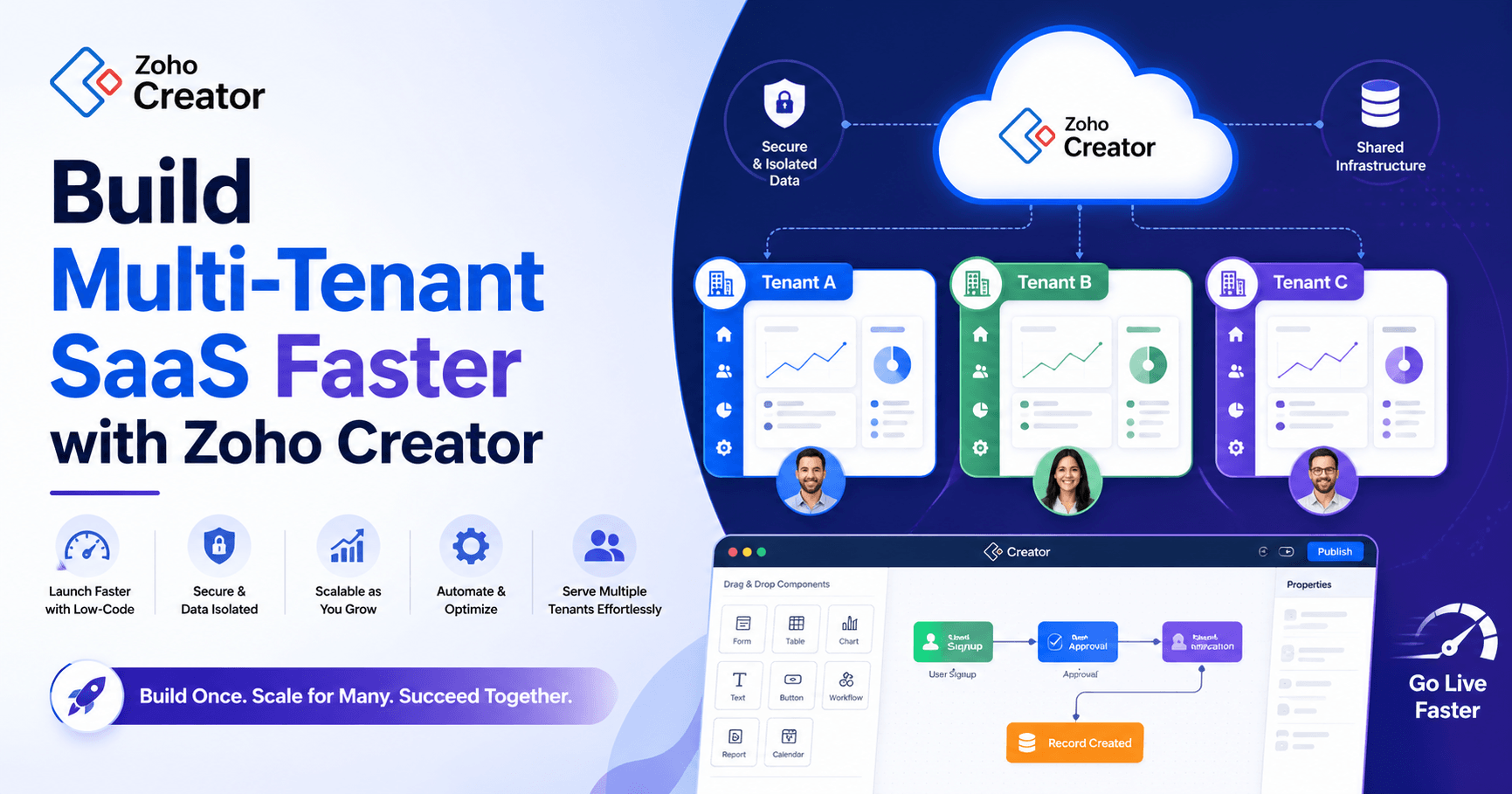
Building a SaaS product sounds exciting until the real work begins.
You have the idea. You know the market pain point. You can picture users signing up, inviting teams, paying subscriptions, and depending on your software every day.
Then reality taps you on the shoulder.
You need user management. Role-based access. Separate customer environments. Billing workflows. Reports. Notifications. Integrations. Security. Scalability. Mobile access. Ongoing updates. Fast deployment.
That challenge becomes even greater when you plan to build a multi-tenant SaaS product.
A multi-tenant architecture allows multiple customers, often called tenants, to use the same software application while keeping their data secure and separated. This model is the foundation of many modern SaaS companies because it reduces infrastructure costs, simplifies updates, and improves scalability.
Traditionally, creating such a platform required hiring developers, architects, DevOps engineers, QA teams, and security specialists. For startups and growing businesses, that can delay launch timelines by months or even years.
This is where Zoho Creator becomes a compelling option.
Zoho Creator is a low-code application development platform designed to help businesses build custom applications quickly, efficiently, and with less dependence on traditional coding.
Zoho Creator is increasingly chosen by startups and growing businesses that want faster product launches without heavy engineering overhead. If you are still evaluating whether low-code is practical for real products, these lessons learned from Zoho Creator users provide useful real-world perspective.
To be honest,building a multi-tenant SaaS product is not just about code. It is about momentum.
You need to move fast, stay lean, often adapt, and serve customers reliably.
Because in SaaS, the first win is not writing code. The first win is getting customers to trust your product enough to pay for it.
Zoho Creator helps you reach that point faster and with more control than traditional development approaches.
If you are considering launching a SaaS platform, internal customer portal, B2B software solution, or subscription-based product, Zoho Creator deserves serious attention. It combines low-code speed with enterprise-grade capability, making it one of the most underrated platforms for building scalable multi-tenant applications.
In this blog post, you will learn why Zoho Creator is an excellent platform for building multi-tenant SaaS solutions, what advantages it offers, and how it can speed up your path to market.
Now, let us dive into the details.
Developing a SaaS Product: Why Platform Choice Matters
Launching a SaaS product may sound exciting, but it quickly raises important questions:
-How fast can you build it?
-What will development cost?
-Can it scale as your customer base grows?
-How will you manage multiple clients securely?
-What happens when feature requests start piling up?
These questions become even more important when building a multi-tenant SaaS product, where one application serves many customers while keeping each customer’s data isolated, secure, and customizable.
Traditionally, companies build multi-tenant SaaS products using full-stack development frameworks such as Node.js, Python, Java, or .NET. That approach can work well, but it often requires large engineering teams, longer timelines, costly maintenance, and constant infrastructure oversight.
This is where Zoho Creator becomes valuable.
Zoho Creator is more than a typical low-code builder. It is a mature application development platform designed to help businesses create scalable, secure, and customizable applications without spending years on traditional development.
For founders, product teams, agencies, and enterprises looking to build a multi-tenant SaaS solution, Zoho Creator offers a clear strategic advantage.
The challenge with traditional development is often not coding alone, but time-to-market, maintenance cost, and evolving scope. This is why many businesses now choose low-code development platforms that simplify custom product delivery, as explained in how Zoho Creator simplifies custom ERP development cost-effectively.
Ready to Turn Your SaaS Idea Into a Real Product?
You do not need years of development or a massive engineering team to get started. With the right platform, your idea can become a scalable product faster than you think.
Before diving into the details, it is important to understand what multi-tenancy means in SaaS.
What Is a Multi-Tenant SaaS Product?
A multi-tenant SaaS product is a single software application that serves multiple customers. Each customer, or tenant, has separate users, separate data, and often separate settings.
Examples include:
- CRM platforms
- HR management tools
- Appointment booking systems
- Inventory systems for franchises
- Compliance portals for multiple clients
- Industry-specific ERPs
- Vendor management platforms
Imagine it's similar to a hotel.
Every guest stays in the same building. They use the same elevators, water system, staff, and security infrastructure. However, each room remains private, personalized, and separate.
That is how multi-tenancy should work in software.
Your platform must provide:
- Data isolation
- Secure access controls
- Custom roles and permissions
- Shared infrastructure efficiency
- Easy onboarding of new tenants
- Centralized updates
- Scalable performance
- Reporting across tenants where appropriate
Building this from scratch is possible. Getting it done efficiently is a different ball game.
If your goal is to launch a multi-tenant SaaS product quickly, scale it wisely, and improve it over time, Zoho Creator is worth serious consideration.
Zoho Creator is often underestimated because it is labeled a low-code platform. That label causes some technical leaders to dismiss it too quickly. However, in practice, it can be a strategic accelerator for founders, product teams, consultants, agencies, and enterprises building subscription software for multiple customers.
A multi-tenant SaaS product comes with unique demands. You need isolated customer environments, shared infrastructure, configurable workflows, role-based access, automation, billing logic, integrations, analytics, performance, and continuous improvement.
Zoho Creator changes the game.
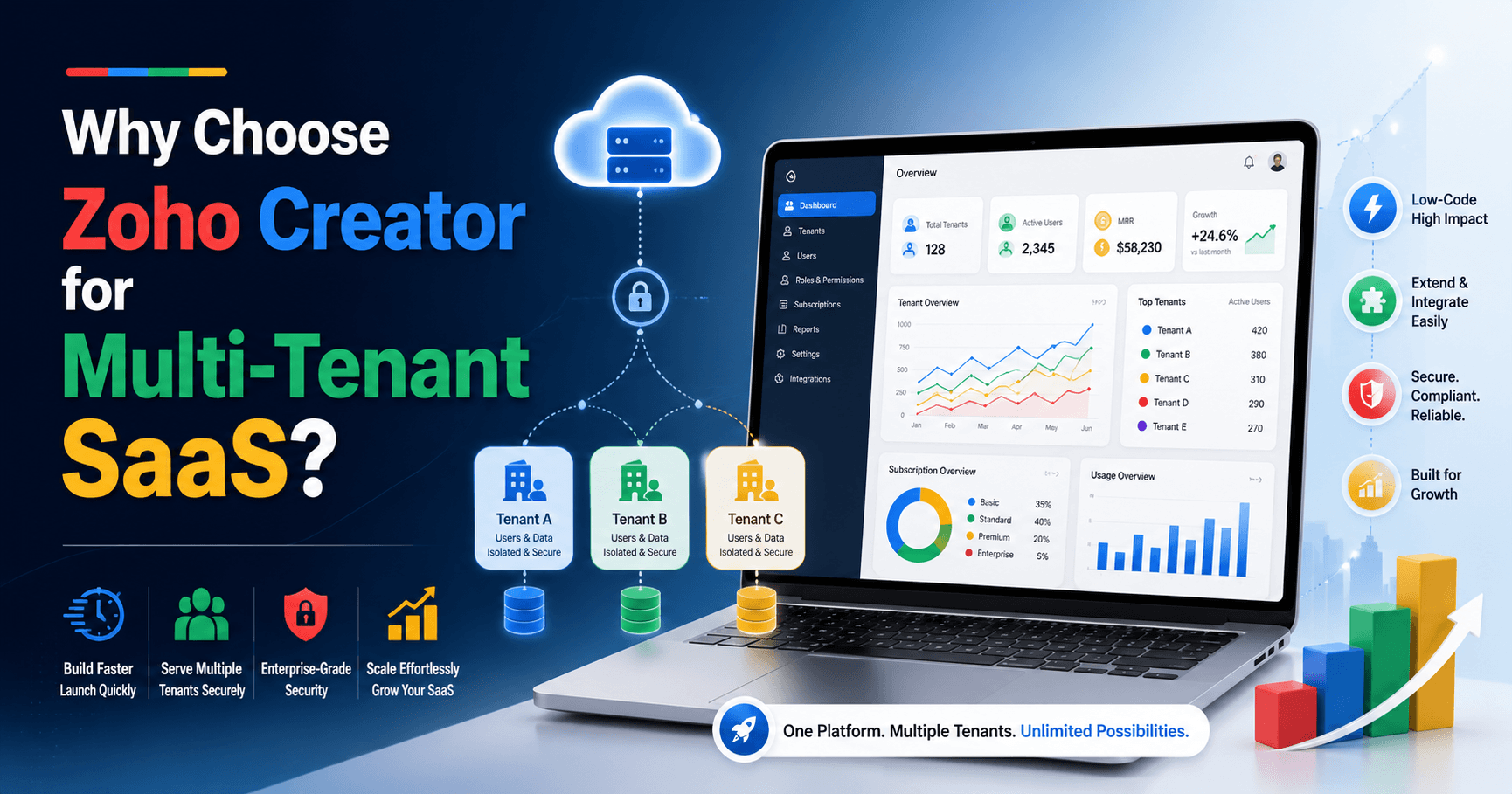
Want to Build a Multi-Tenant SaaS Platform Without Complexity?
Multi-tenancy can unlock recurring revenue, faster scaling, and lower operational costs, but only when built correctly.
Why Building Multi-Tenant SaaS from Scratch Can Be Painful
A multi-tenant SaaS product is a software application where many customers, often called tenants, use the same core system. Their data, settings, permissions, and user experience stay separate and secure.
Examples include:
- CRM platforms
- HR systems
- Project management tools
- Industry-specific ERPs
- Membership platforms
- Booking systems
- Franchise management software
- Customer portals
Imagine an apartment building.
Every tenant lives in the same building, uses shared utilities, and benefits from common maintenance. Yet each apartment remains private, secure, and personal.
That is multi-tenancy done right.
Because resources are shared wisely, the business benefits can be significant:
- Lower operating costs
- Faster updates for all customers
- Centralized maintenance
- Easier scaling
- Predictable recurring revenue
- Standardized support
However, building this type of system from scratch can be a tough road to travel. You must solve complex technical problems before selling your first subscription.
These often include:
- Data separation and security
- User roles and permissions
- Billing and subscription management
- Performance at scale
- Custom settings for each customer
- Updates without disruption
If your business model depends on testing an idea quickly, this path can slow you down and eat up time.
Zoho Creator helps reduce that burden dramatically. It allows businesses to build custom SaaS applications using a low-code framework backed by enterprise-grade infrastructure.
Instead of coding everything manually, you use visual builders, workflows, automation logic, integrations, and data models to launch products faster.
This helps businesses launch faster, reduce development effort, and focus on customer needs.
For multi-tenant SaaS businesses, this creates a huge strategic edge.
If your goal is to launch a useful SaaS product quickly and scale intelligently, Zoho Creator is not just an alternative to traditional development. It may be the strategic advantage that gets you to the market first.
The best SaaS products are not always built by teams with the biggest engineering budgets. More often, they are built by teams that move fast, listen closely, and solve real problems early.
If you are planning to launch a multi-tenant SaaS product, Zoho Creator deserves serious consideration.
The next section explains why.
Key Reasons for Choosing Zoho Creator to Build Multi-Tenant SaaS App
Here are the key reasons businesses choose Zoho Creator for building multi-tenant SaaS products:
Reason #1: Build a Multi-Tenant SaaS Architecture with Zoho Creator
This is where Zoho Creator truly stands apart from nearly every other low-code platform on the market. Most low-code tools are built for internal applications. They are excellent for workflow automation, departmental systems, and operational apps.
However, multi-tenant SaaS requires a very different architecture, and most low-code platforms were not designed for it.
Zoho Creator was.
Zoho Creator provides native portals, user permissions, roles, and data-sharing capabilities that can be configured as part of a multi-tenant SaaS architecture. Customers can be given controlled access to the application through Creator portals, with portal users assigned appropriate permissions and access to application components and data.
In a Zoho Creator implementation, "multi-tenant" does not necessarily mean creating a separate Creator application for every customer. A shared application can serve multiple tenants while user access and data visibility are configured according to each tenant's requirements. The exact architecture depends on the product's isolation, customization, integration, and security requirements.
Zoho Creator provides application-level security and access-control mechanisms that can be configured to restrict users' access to data and application components. The application can be configured so that users only access the records they are authorized to view or modify. For a multi-tenant implementation, tenant-specific access rules should be designed, configured, and tested as part of the application's security model.
When multiple tenants use the same Creator application, changes to the shared application are managed centrally. For applications using Creator 6 environments, changes can be developed, tested, and deployed through the Development, Stage, and Production environments. Zoho Creator gives you that capability right out of the box.
Reason #2: Low-Code Speed Without Sacrificing Customization Depth
One of the most common objections to low-code platforms is the belief that they have limits.
Many people say, “You can build fast, but eventually you will hit a wall when you need something custom.” With Zoho Creator, that limit is far higher than most people expect.
Deluge, Zoho Creator’s built-in scripting language, is genuinely capable. It is influenced by Python, easy to read, and powerful enough to handle complex business logic, conditional workflows, custom calculations, API integrations, and data transformations.
You are not limited to clicking through menus for every special case. You can write real logic that works the way real businesses need it to work.
In addition, Zoho Creator supports native REST API connections to external services. You can pull payment data from Stripe, integrate with Twilio for SMS notifications, connect to HubSpot or Salesforce or any CRM you use for data to sync, or build two-way integrations with almost any platform that offers a public API.
Low-code development platform- Zoho Creator also offers custom server-side functions, scheduled tasks, and front-end widgets built with JavaScript and CSS.
To ensure your application performs efficiently, it is important to follow optimization practices outlined in 10 Expert Tips to Optimize Your Zoho Creator App Performance and User Experience.
Zoho Creator combines speed with flexibility through Deluge scripting and API integrations.
However, it is important to understand platform boundaries before scaling your SaaS product. These limitations and solutions are explained in Zoho Creator Limitations and Workaround.
Reason #3: White-Labeling and Branding: Selling Your SaaS, Not Zoho’s Brand
One concern that often comes up when founders consider platform-based development is brand perception.
“If I build on Zoho Creator, will my customers know? Will it look like a Zoho product?”
The answer is no, and that is intentional.
Zoho Creator’s white-labeling capabilities are extensive. You can launch your SaaS product on a custom domain, such as yourproduct.com, instead of zoho.com. You can apply your own branding, colors, fonts, and logos throughout the interface. Your customers will not see Zoho branding unless you choose to display it.
From the outside, your product remains fully yours. The fact that it runs on Zoho Creator stays invisible to end users.
This matters greatly for enterprise deals and brand positioning. When you enter a sales conversation with a mid-market or enterprise prospect, you are presenting your solution, your team, and your vision. The platform behind the scenes is a secondary detail. What matters is that the product looks professional, performs reliably, and solves the customer’s problem.
Zoho Creator helps make all three possible without requiring a large engineering team.
Custom domains also strengthen SEO and trust. When your SaaS product lives at app.yourcompany.com instead of yourcompany.zoho.com, it signals professionalism and long-term stability to prospects and investors alike. The branding separation is clean, complete, and credible.
You can also enhance user experience through advanced design strategies covered in Advanced UI and UX Customization Tips for Your Zoho Creator App.
Reason #4: Role-Based Access Control at Scale: Managing Complex Permissions
Permission systems are one of those features that seem simple at first glance but become genuinely complex in production.
Users within the same tenant often require different access levels. A tenant admin may need full control. Regular users may need limited access. Your internal team, as the SaaS provider, may need super-admin visibility across all tenants for support and maintenance, without disrupting each tenant’s own administration.
Zoho Creator handles this through a layered permission architecture that fits naturally with multi-tenant requirements.
You can define roles at the application level. Within the shared application, users can be assigned appropriate roles and permissions based on their responsibilities and access requirements. Your super-admin access remains separate. The full hierarchy can be configured without building permission logic from scratch.
For enterprise clients, this level of control is not optional.
-A hospital using your platform may need doctors to view patient fields that billing staff cannot access.
-A financial services firm may require maker-checker workflows.
-An educational institution may need teacher, student, and administrator roles with entirely different permissions.
Zoho Creator’s permission framework handles all of these scenarios without having to create custom RBAC.
Reason #5: Workflow Automation That Makes the Product Feel Intelligent
A key difference between a truly exceptional SaaS product and an average one is the sense of intelligence and automation that shapes the user experience.
When an event occurs in the system, the right response happens instantly, without manual effort. Approvals move to the right people. Notifications go out at the right time. Data updates in the right places. Reports run on schedule. The product feels proactive instead of passive.
Zoho Creator’s workflow automation engine is powerful enough to support all of this without requiring custom code. You can define:
- Triggers: a new record is created, a field value changes, a date condition is met, or a form is submitted.
- Conditions: only run the workflow when specific criteria are true.
- Actions: send an email, update a record, call an API, run a Deluge function, notify a user, or create a task.
This is especially valuable for SaaS products because these workflows can be designed to process records according to the business and tenant context defined within the application. You create the automation logic once in your central application, and it runs correctly for each tenant’s data.
Records from Tenant A trigger workflows meant only for that tenant, while Tenant B’s records remain fully separate. The automation system naturally supports the multi-tenant structure and preserves data isolation.
For SaaS founders, this means you can build advanced product features such as subscription workflows, automated onboarding sequences, SLA alerts, data export routines, recurring billing triggers, and other business-specific logic, Zoho Creator's native automation, Deluge scripting, APIs, and integrations can reduce the amount of custom backend development required.
However, it is important to balance automation with logic. Overusing automation can create inefficiencies. This balance is explained in When to Use AI and Manual Logic in Your Zoho Creator App.
If you are looking to enhance automation further using AI, explore How AI in Zoho Creator accelerate App Development.
Reason #6: Scalability: Can It Handle Real Growth?
This is the question many founders ask, and it is a fair one. When your SaaS product has 10 tenants, almost any architecture can work.
But what happens when you have 500 tenants, 5,000 users, or growing data volumes? Does Zoho Creator still hold up?
The honest answer is yes, within the right context and with clear expectations.
Zoho Creator is built on Zoho’s enterprise-grade infrastructure, which powers the broader Zoho ecosystem used by millions of businesses worldwide. The platform handles substantial data volumes, concurrent users, and complex application logic reliably.
Zoho Creator can be a practical platform for many business-focused SaaS applications, but scalability should be evaluated against expected users, data volumes, concurrency, workflows, integrations, and application complexity.
Where you need to be thoughtful is at hyper-scale. If you are building a product for hundreds of thousands of concurrent users with highly complex real-time operations, you may eventually need to evaluate whether a platform-based solution or custom-built infrastructure are the right long-term options.
But here is the practical reality: very few SaaS products ever reach those limits. If yours does, you will likely have the revenue, traction, and investment needed to make more advanced infrastructure decisions at that stage.
The more common reason startups fail is never reaching product-market fit because they spent early resources building infrastructure instead of building products customers wanted.
Build fast. Validate hard. Scale wisely.
Zoho Creator can support SaaS products across different stages of growth, but the appropriate architecture should be evaluated against the application's expected scale, complexity, integrations, and operational requirements.
For advanced backend capabilities, Zoho Creator developers can extend functionality using serverless architecture. Learn more about Why Zoho Catalyst Is Best for Serverless App Development and what makes them to choose over Amazon AWS.
Reason #7: Deep Integration with the Zoho Ecosystem
For Zoho users, one of the biggest advantages of using Zoho Creator is its strong native integration with the broader Zoho ecosystem.
Zoho Creator supports integrations with several Zoho applications and external services through available integrations, connections, APIs, and other integration mechanisms. The implementation approach depends on the products involved and the data that needs to be exchanged.
For example, a SaaS application built with Creator can be integrated with Zoho CRM when customer, account, sales, or other business data needs to move between the two systems. The specific integration design should be determined based on which system owns each data set, synchronization requirements, and the operations that need to be automated.
In many SaaS scenarios, this level of ecosystem integration creates major value. For billing, you can connect directly with Zoho Subscriptions or Zoho Books.
For customer support, Zoho Desk offers native integration. If your product generates data that clients want to analyze, Zoho Analytics works smoothly with Creator.
You do not need to build integrations from the ground up or manage external middleware. Instead, you can rely on Zoho’s first-party connections, which are maintained and updated by Zoho.
For customers who already use Zoho, your SaaS product fits naturally into their existing technology stack instead of standing alone. This can be a major advantage in enterprise sales, where compatibility with current systems often tips the scales.
Reason #8: Managed Infrastructure and Enterprise-Grade Security
A major concern for SaaS founders is infrastructure reliability and security compliance. Once a customer gives you access to business data, your responsibility goes far beyond product features. They trust you with sensitive information, and any breach, outage, or data loss could seriously harm their operations.
Building enterprise-grade infrastructure requires skill, time, and significant investment, resources that many early-stage SaaS companies do not have. You may need 99.9% or higher uptime, regular backups, encryption at rest and in transit, disaster recovery systems, and certifications such as SOC 2 and ISO 27001. Building all of this from scratch as a small team can be an uphill battle.
By building on Zoho Creator, you gain access to Zoho’s mature infrastructure. Zoho operates data centers across multiple global regions, provides high availability, encrypts data at rest and in transit, and maintains important compliance certifications. This foundation is backed by more than 20 years of experience delivering cloud software at scale to millions of users worldwide.
This does not imply application security can be ignored. You still need to configure strong access controls, and secure data models. However, the infrastructure layer, one of the most expensive and specialized parts of running a SaaS business, is largely handled for you.
That gives you a stronger position when speaking with enterprise clients. You can explain that your product runs on Zoho’s secure infrastructure and direct them to Zoho’s security documentation, which often helps during vendor review processes.
Reason #9: Pricing Economics: What Building on Creator Actually Costs
A key factor for any SaaS developer is understanding the cost structure of the business. The expenses required to build and deliver the product have a major impact on profit margins and long-term sustainability.
Let me break this down clearly.
Building a multi-tenant SaaS platform from scratch usually involves developer salaries, infrastructure costs such as servers, databases, CDN services, and monitoring tools, plus third-party services like authentication, email, and storage. It also includes ongoing maintenance and support.
For a small team, startup costs can easily range from $30,000 to $80,000 before the first customer becomes a paying customer. Those costs also continue after launch.
With Zoho Creator, the main expense is a Creator subscription, typically priced per user, per month. Costs vary based on the plan and the number of users, but the platform is designed to be accessible for small teams and to scale smoothly as your customer base grows.
The commercial and licensing model for a SaaS product built with Zoho Creator depends on factors such as application architecture, users, portal requirements, deployment model, and the applicable Zoho licensing terms. These details should be confirmed with Zoho before finalizing the product's commercial model.
Infrastructure, security, uptime engineering, and platform maintenance are included within that subscription model. When you compare total ownership costs with custom development, Creator is often significantly cheaper, especially during the first 12 to 24 months when capital efficiency matters most.
This pricing model also means the cost of adding a new tenant is relatively low. When you sign a new customer, you are not building new infrastructure from the ground up. Zoho Creator provides portal capabilities that can simplify the process of providing external users with controlled access to the application.
That kind of scalability, without matching cost increases, is one reason SaaS businesses are finding Zoho Creator is the smart choice.
Cost vs. Opportunity Cost
Founders often compare only the subscription price.
That is often the wrong comparison.
A better comparison is:
Zoho Creator subscription cost vs. months of delay + engineering payroll + missed market timing + product uncertainty
That perspective can change the decision quickly.
If Zoho Creator helps you validate your product in 45 days instead of 180 days, the upside for the business can be substantial.
Reason #10: Analytics and Reporting: Giving Your Tenants Actionable Insights
A SaaS product lacking robust reporting is much like a car without a dashboard. Customers need to understand what is happening with their data, track key metrics, and make informed decisions. If reporting is weak, customer churn may increase.
Zoho Creator includes a powerful built-in analytics and reporting module that can be shared with tenants. You can create custom reports, charts, dashboards, and pivot tables using your application data, with access controlled according to the user's role, permissions, and the application's tenant-specific access rules.
Users can be configured to access only the records and application components they are authorized to access. Tenant-specific filtering and access rules should be designed and tested as part of the application's implementation.
Beyond Creator’s built-in reporting, Zoho Analytics adds a dedicated business intelligence layer that integrates deeply with Zoho Creator data. If your SaaS product needs advanced intelligence features, embedding Zoho Analytics can provide capabilities similar to standalone BI platforms.
Interactive dashboards, drill-down reporting, AI-powered insights through Zia Analytics, and scheduled report delivery are all available without building a custom analytics stack.
For SaaS products in data-heavy industries such as logistics, healthcare, finance, or manufacturing, reporting is often a major value driver.
Customers are not paying only to store data. They are paying to understand it and act on it.
A strong embedded analytics experience increases perceived value, improves retention, and supports expansion revenue.
Takeaway:
If you are serious about building a multi-tenant SaaS product, stop viewing Zoho Creator as a compromise and start seeing it as the strategic advantage it can be.
Comparing Zoho Creator with Building a Custom Solution from Scratch: An Honest Assessment
The decision between Zoho Creator and building a custom solution from scratch depends on your business goals, technical needs, timeline, and available resources.
For organizations that value speed, simplicity, and cost-efficiency, Zoho Creator offers a smart and scalable alternative.
For businesses with highly complex or constantly evolving requirements and the budget to support long-term development, building from scratch can provide greater flexibility and control.
If you are deciding between low-code and full custom development, refer to Zoho Creator vs Custom Development and discover which path is suitable for your business.
It is also worth noting that many companies choose a hybrid approach. They use Zoho Creator for core, repetitive processes while building custom modules only where necessary. This approach helps teams get the best of both worlds, reducing risk while maximizing return on investment.
To be fair, Zoho Creator is not the right fit for every SaaS product.
If you are building a consumer-facing platform that requires a highly customized user interface, real-time multiplayer functionality, native mobile apps with advanced device integrations, or specialized large-scale computation, a custom-built architecture is likely the better choice.
However, for business-to-business SaaS products in areas such as productivity, operations, compliance, HR, finance, project management, or niche industry solutions, Zoho Creator is not just a viable option. It is often the smarter one.
Development timelines can be measured in weeks rather than years. Total ownership costs are significantly lower. Because the platform is already mature and battle-tested, you benefit from years of proven enterprise software engineering instead of reinventing the wheel. Its scalability is also more than sufficient for the growth needs of most SaaS businesses.
If your goal is to build a scalable, flexible, and maintainable SaaS product without getting buried in infrastructure and repetitive development work, Zoho Creator is a strong and practical choice.
The biggest advantage is not just speed. It is the freedom to focus on solving real customer problems while the platform handles the rest.
If you are exploring how quickly you can build and launch applications, refer to How to Turn Your Idea into App Fast Using Zoho Creator.
Need Expert Help to Launch Your Product Faster?
If you want to skip trial and error and build your SaaS product the right way from day one, working with an experienced Zoho partner can make a significant difference.
Working with experienced Zoho Creator Experts can significantly reduce development risks and improve outcomes. If you are evaluating zoho creator or want to get the most out of Zoho Creator, this guide on finding the best Zoho partner in India can help you make the right choice.
Practical Example: Building a Compliance SaaS App using Zoho Creator
Picture creating a compliance solution tailored for manufacturing businesses.
You need:
- Multi-company login
- Plant-wise data access
- Audit forms
- Incident tracking
- Reminder alerts
- Document expiry notifications
- Reports for leadership
- Subscription plans
Custom development could lead to a lengthy and costly process.
With Zoho Creator, many core components can be assembled quickly and refined based on customer needs.
That means you can sign pilot customers earlier, collect feedback sooner, and improve from real usage.
That is how practical SaaS businesses are built.
Want to build a SaaS product without the complexity and higher development costs?
Zoho Creator offers a subscription-based pricing model, making it a more budget-friendly option compared to the upfront costs of custom development.
Final Verdict
Choosing a low code development platform for your multi-tenant SaaS product is not only a technical decision. It is also a business decision. You need speed, flexibility, cost control, security, rapid iteration, and room to grow without infrastructure becoming a liability.
Zoho Creator meets those requirements effectively because it provides a combination of application development, portals, permissions, automation, integrations, and deployment capabilities that can support many multi-tenant SaaS use cases. The right architecture depends on how tenants, data, users, integrations, security, and application deployment need to be managed.
In SaaS, momentum is often more valuable than architectural perfection. Customers do not care whether you custom-built every backend service. They care whether the product solves their problem, works reliably, and improves over time.
If your SaaS idea solves a real business problem, Zoho Creator can help you move from concept to paying customers faster than traditional development.
If you have been delaying your SaaS idea because you think you need more developers, more funding, or more time, Zoho Creator can remove many of those barriers.
When you are ready to launch commercially, consider hiring a Zoho Partner, such as YAALI Bizappln Solutions, if you have not already. They have experience deploying Creator applications in production SaaS environments and can help accelerate development. They can also support your licensing strategy and help structure your commercial model more effectively from the start.
Before launching your SaaS application, it is critical to validate performance, workflows, and security. A structured checklist like 10 critical steps to check before deploying your Zoho Creator app can help ensure a smooth launch.
Ready to turn your SaaS idea into a working product faster?
Stop waiting for the “perfect” tech stack. Start building with Zoho Creator and validate your idea in weeks, not months.
Consult with our Zoho Creator Expert to launch your MVP today and validate your idea in weeks,not months.
Or Working with our seasoned Zoho Creator Expert who can bring your product to life.
Let us know how we can help you with Zoho Creator
ATTENTION: Sign up through our exclusive Zoho Creator Partner Link to get personalized support and expert guidance every step of the way for your app development.
Share this Post if you found this Content Useful. Sharing is Caring😊
📧 Join over 1000+ Business Owners, Zoho Customers, Consultants, and Zoho Partners who read our content to get the most out of Zoho for their business.
▣ Zoho + Your Business+ Our Expertise = Get Maximum Value out of your Zoho Investment.

Enter Your Email Address Below to receive the Exclusive Content that we only share with those who Subscribe to our Newsletter.


