10 Best Zoho CRM Implementation Partners in India (Unbiased)
Discover the 10 best Zoho CRM implementation partners in India for 2026, compare their implementation capabilities, customization expertise, integrations, automation, and ongoing support, and understand what sets each apart. Learn what to evaluate before choosing a Zoho CRM Partner.

Paying Subscription for Zoho CRM is straightforward. Making it work across your business is where the real challenge begins.
Your marketing team generates leads, your sales team follows up, managers forecast revenue, and finance handles quotations and payments. But when these activities rely on spreadsheets, disconnected applications, and manual work, simply installing a CRM will not solve the problem. Your CRM must connect these processes, automate routine tasks, enforce the right workflows, and give management reliable data to make informed decisions.
That takes more than basic CRM configuration. A successful CRM implementation requires careful process planning, automation, data migration, application integrations, customization, and ongoing support after go-live. For a closer look at the process, see our guide to Zoho CRM implementation services and what to expect.
India has several Zoho CRM implementation partners, but their capabilities vary. Some focus on standard CRM setup, while others offer advanced customization, complex integrations, and end-to-end implementation services.
Choosing the right Zoho CRM Partner can make the difference between a CRM that simply stores customer information and one that helps your business run more efficiently.
This insightful blog post evaluates and ranks 10 Zoho CRM implementation partners in India based on their implementation capabilities, technical expertise, documented project experience, and ability to support businesses beyond the initial deployment.
The ranking is an editorial assessment, not an official Zoho ranking. The objective is to help businesses identify a Zoho Partner that can solve their actual operational problems, rather than one that simply sets up Zoho CRM and moves on. The distinction matters: a well-chosen partner configures the system to work the way your business needs it to work.
How We Evaluated the Best Zoho CRM Implementation Partners
A ranking is only useful when readers can clearly see what separates one partner from another.
Many comparison articles focus on basic company information, Zoho partner status, years in business, or a list of services. These details provide useful context, but they do not show whether a partner has the practical capabilities needed to deliver a successful CRM implementation.
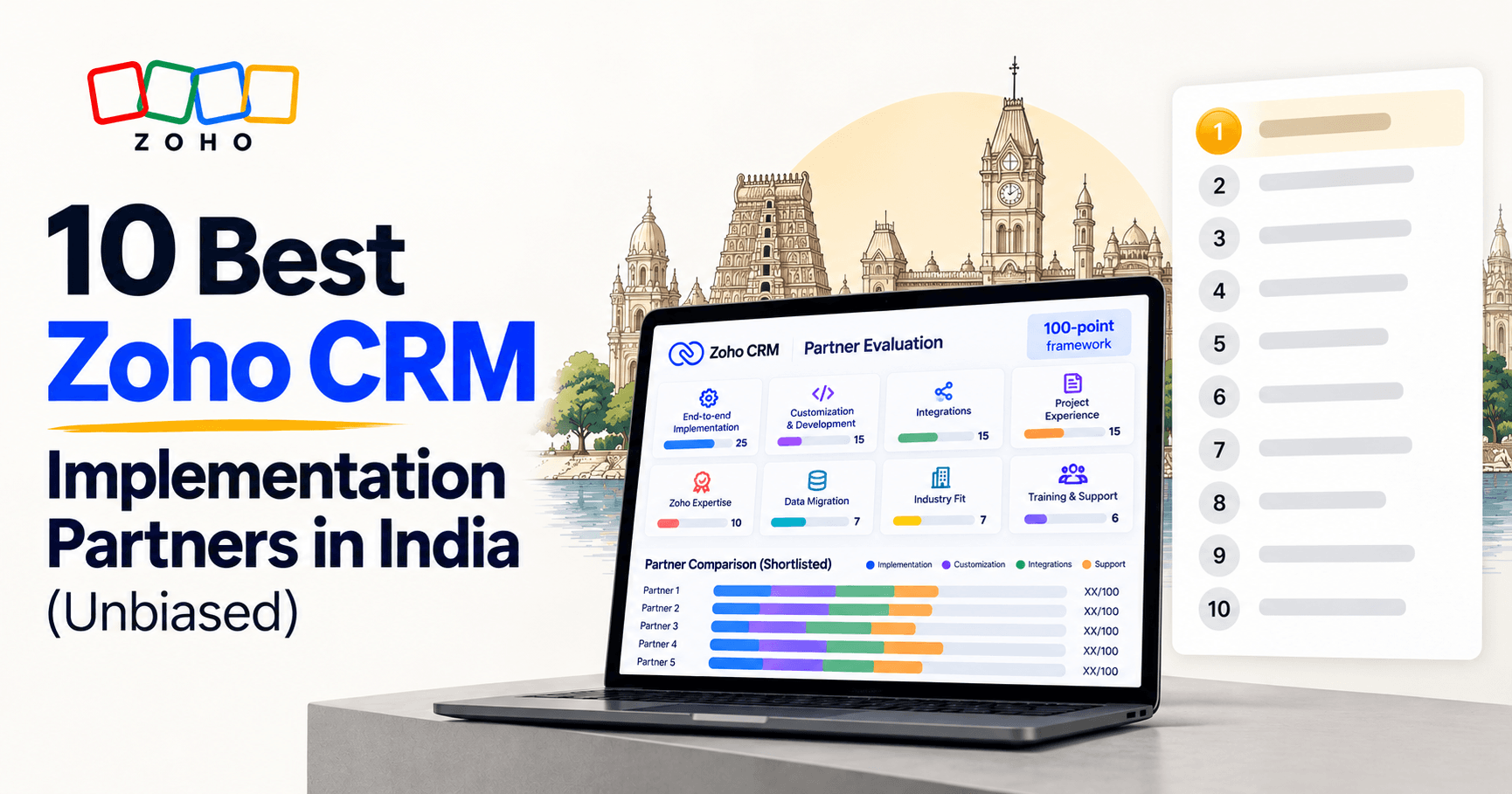
For this guide, we evaluated each partner using a 100-point evaluation framework across eight key dimensions of Zoho CRM implementation capability.
The framework gives the greatest weight to end-to-end implementation capability. A partner may be able to configure Zoho CRM, but that alone does not make them the right choice for a complex project. Successful implementation often requires business process mapping, customization, data migration, third-party integrations, automation, testing, user training, deployment, and post-launch support.
In other words, we looked beyond what partners say they offer and focused on what they are equipped to deliver. This approach helps create a more practical and consistent comparison for businesses evaluating Zoho CRM implementation partners.
Not sure which Zoho CRM partner is right for your business?
Getting this decision wrong is costly. YAALI's team can review your CRM requirements and give you a clear picture of what your implementation should cover before you sign with anyone.
Zoho CRM Partners Evaluation Framework
Criterion | Maximum points | What is evaluated |
End-to-end Zoho CRM implementation | 25 | Discovery, process mapping, architecture, configuration, testing, deployment, and post-launch improvement |
Customization and development | 15 | Custom modules, functions, Deluge, widgets, Creator applications, and extensions |
Integrations and technical capability | 15 | APIs, external applications, ERP, accounting, ecommerce, and other business systems |
Implementation experience and case evidence | 15 | Relevant case studies, documented projects, project complexity, and customer evidence |
Zoho expertise and recognition | 10 | Official partner information, relevant awards, certifications, and ecosystem participation |
Data migration | 7 | Data cleansing, mapping, deduplication, migration, and validation |
Industry and business-process expertise | 7 | Evidence of relevant industry experience and complex workflows |
Training, support, and optimization | 6 | User training, post-launch assistance, maintenance, and continuous improvement |
Total | 100 |
|
Each criterion can be rated from zero to five based on publicly documented evidence. Its weighted score is calculated as:
Weighted score = (Evidence rating ÷ 5) × Criterion weight
For example, a rating of 4 out of 5 for end-to-end implementation produces 20 out of 25 points.
The overall score is the sum of all eight weighted scores.
What Counts as Evidence?
The methodology distinguishes between evidence of actual implementation capability and general marketing claims.
Evidence may include:
- Zoho's official partner directory and award announcements.
- Published Zoho Marketplace vendor profiles.
- Detailed Zoho CRM implementation case studies.
- Named customer testimonials and references.
- Documented integrations and custom applications.
- Clearly explained implementation methodologies.
- Verifiable project outcomes and technical deliverables.
A general claim such as "We are experts in Zoho CRM" is not enough to earn a high score. We look for supporting evidence that shows what the partner has actually built, implemented, integrated, or delivered.
Similarly, a Zoho Partner tier provides useful evidence of a company's standing within the Zoho ecosystem, but it does not, by itself, prove that the company is the best fit for a particular Zoho CRM implementation.
The best Zoho CRM Implementation Partner should be judged on more than its Zoho credentials. The real question is whether it can translate business requirements into a working CRM system and carry the project through from discovery to deployment and optimization.
Important: This is an editorial shortlist, not an official Zoho ranking. The order reflects the evaluation framework described above, with end-to-end implementation capability receiving the greatest weight. Individual scores should be interpreted as assessments of publicly documented evidence, not guarantees of delivery quality or customer outcomes.
Before looking at who can deliver, it helps to understand what a complete Zoho CRM implementation should actually cover. Many businesses discover the full scope only after signing with a partner, which makes it harder to compare proposals or identify gaps.
The following section sets out that scope so you can evaluate each partner against a consistent standard.
What a Complete Zoho CRM Implementation Covers
Different Zoho Partners use the phrase "end-to-end implementation" to describe very different levels of service.
Before hiring a Zoho CRM Partner, make sure you understand what a complete implementation should include and use this checklist to evaluate each proposal you receive.
1. Business Discovery and Process Mapping
The Zoho Implementation Partner should document your existing sales process before recommending how Zoho CRM should be configured. This includes lead sources, qualification criteria, sales stages, approval requirements, reporting needs, and handoffs between teams or departments.
For example, if a sales representative cannot move an opportunity to the proposal stage until a technical assessment is complete, the CRM should enforce or clearly reflect that requirement.
Without proper process mapping, an implementation may simply carry existing inefficiencies into a new system. Our guide to the key steps for successful Zoho CRM implementation explains how to structure the process from planning through launch.
2. CRM Architecture and Configuration
This stage defines the modules, fields, layouts, relationships, roles, profiles, permissions, and sales pipelines that make up your CRM.
A good design meets business needs without making the CRM difficult to maintain. Adding a field for every request may seem convenient, but unnecessary fields and overlapping modules can make the CRM harder to use over time.If your processes need more tailored functionality, read why you may need to customize Zoho CRM for your business.
The Zoho Partner should be able to explain why each major design decision is necessary and how it supports your business process.
3. Data Migration and Validation
Moving data from spreadsheets or another CRM requires more than importing a file.The team should identify duplicates, standardize fields, map relationships, preserve important records, and validate the migrated data.
A migration plan should also explain how notes, activities, attachments, historical deals, and ownership information will be handled based on the source system and migration requirements.
Before go-live, your team should be able to compare sample records against the original data and confirm that the migrated information is accurate. You can also review our guide to keeping Zoho CRM data clean for practices that help maintain reliable records after migration.
4. Workflow Automation and Custom Development
Automation should eliminate manual work without making the system difficult to maintain. Examples include assigning leads, creating follow-up tasks, notifying managers, triggering approvals, and updating records when specific conditions are met.
Custom functions may be necessary when standard Zoho CRM features cannot support a specific business rule. The partner should document these functions and test both normal scenarios and exceptions. A good partner should also help you avoid the common mistakes made during Zoho CRM implementation, including unnecessary complexity and poorly tested automation.
5. Integration with Other Systems
An integration plan should identify the systems involved, the data exchanged, the direction of synchronization, the frequency of updates, and how integration errors will be detected and handled.
For instance, connecting CRM with an accounting application may require clear rules for customer creation, invoice references, payment status, and record ownership.
A successful integration does not merely transfer data. It keeps information consistent across systems and gives employees a dependable view of the information they need.
6. Reporting and Management Visibility
Dashboards should answer real business questions.
Can your sales manager identify which lead sources generate qualified opportunities? Can leadership see pipeline value by stage?
Can managers identify deals that have stalled? Can the company compare conversion rates across sales teams?
These questions should shape the reports, not the other way around. A well-designed CRM should help managers spot problems, understand performance, and make decisions without having to dig through spreadsheets or manually compile data.
For more ideas on improving reporting and making better use of CRM data, explore these hidden Zoho CRM features that sales teams often overlook.
7. User Training and Adoption
Employees need to understand how the CRM fits into their daily work.
Training should be role-specific. Sales representatives need to know how to manage leads and opportunities. Managers need to know how to review pipeline performance and coach their teams. Administrators need to understand permissions, workflows, and routine maintenance.
Training should also explain why the new processes matter. If the CRM adds work without providing visible benefits, employees may fall back to spreadsheets, personal notes, and informal communication. User adoption is therefore a design issue as much as a training issue.
8. Go-Live, Monitoring, and Continuous Improvement
Go-live is not the end of the implementation.
The Zoho CRM Implementation partner should help resolve post-launch issues, monitor automation, collect user feedback, and prioritize improvements. The handover should include documentation, access details, known limitations, and a clear support process.
The first few weeks after go-live can reveal problems that were difficult to identify during testing. A capable partner should have a process for identifying these issues, fixing them, and improving the system without disrupting day-to-day operations.
This is where a Zoho Partner's ongoing support capability becomes critical. A successful Zoho CRM implementation should not only work on day one. It should continue to support the business as its processes, teams, and requirements evolve. A post-launch review can also help identify the root causes of Zoho CRM implementation failures before they affect adoption or reporting.
With a clear picture of what complete implementation involves, you can now evaluate each partner against that standard.
The 10 partners below are ranked by their demonstrated capability across the eight dimensions described above.
Are You Getting the Most Out of Your Zoho CRM?
Discover what's working, what's holding you back, and how to make your Zoho CRM work better for your business in just 30 minutes.
Let's Talk See Our Zoho Expertise →Top 10 Best Zoho CRM Implementation Partners in India
Here are the best Zoho CRM Implementation Partners in India
1. YAALI Bizappln Solutions 👑
Best for: End-to-end Zoho CRM implementation, customization, automation, integrations, and custom development.
A successful Zoho CRM implementation should do more than configure modules, fields, and workflows. It should fix the problems that make your sales process difficult to manage, whether that means inconsistent data, disconnected applications, manual work, or workflows that do not fit the way your business operates.
YAALI Bizappln Solutions takes an end-to-end approach to Zoho CRM implementation. Founded in 2016 by former Zoho and ManageEngine professionals, the company combines Zoho expertise with full-stack development capabilities. This combination becomes valuable when a business needs more than standard CRM configuration, such as complex sales processes, Deluge automation, third-party integrations, legacy data migration, or custom functionality.
Instead of treating CRM implementation as a one-time setup, YAALI can connect CRM with the wider business ecosystem and build workflows around the company's actual processes. This makes it a strong fit for businesses that need to customize Zoho CRM, integrate it with other systems, automate repetitive work, or extend its capabilities as their requirements grow.
That is why YAALI ranks first in this guide: its strength is not simply implementing Zoho CRM, but turning it into a connected system that supports how the business actually sells, operates, and grows.
Best suited for: SMEs and growing businesses that need a complete Zoho CRM implementation, with customization, legacy data migration, third-party integrations, complex automation, and ongoing technical support.
Need help getting maximum value out of Zoho CRM for your business?
From process discovery to go-live and beyond, YAALI handles the full CRM implementation lifecycle. Share your requirements and get a no-obligation assessment of your project scope, timeline, and approach.
Contact us Now Consult with Our Zoho Expert →
2. Nexivo Consulting
Best for: Broader Zoho Transformation
Nexivo Consulting is a Zoho-focused consulting company offering services across CRM, Zoho One, custom applications, integrations, and business automation.
Its published case studies cover projects across multiple industries and Zoho applications, including CRM, Creator, Desk, and other business systems.
Nexivo may be a strong fit when CRM is only one part of a larger business transformation. A company may need to connect sales, customer support, finance, project management, and reporting, rather than implementing each system separately and hoping they align later.
This multi-application approach becomes important when data needs to move between departments and business processes need to work together. Rather than setting up individual Zoho applications in isolation, the implementation needs to tie them into a connected operating environment.
Best fit: Mid-market and enterprise businesses planning multi-application Zoho deployments, cross-functional workflows, or a wider business automation initiative.
3. Fristine Infotech
Best for: Enterprise Technology and Financial Services
Fristine Infotech is a Pune-based enterprise technology company and Zoho Premium Partner. Its public positioning focuses on financial services, enterprise operations, data platforms, and AI-enabled solutions.
This focus makes Fristine relevant to financial services organizations that need CRM to work alongside operational systems, financial data, approval processes, and governance requirements.
For these businesses, CRM implementation is rarely limited to sales automation. Data quality, access control, audit trails, system integration, and consistent business processes can be just as important. The CRM therefore needs to fit into the organization's wider technology environment rather than operate as a standalone application.
Best fit: Financial services companies, regulated businesses, and organizations with complex operational, data, governance, or integration requirements.
4. V-Align Technologies
Best for: Multi-Application Zoho Implementations
V-Align Technologies provides Zoho implementation and enterprise application services across CRM, Creator, analytics, integrations, and business automation.
V-Align reports more than 1,500 projects and 450 or more clients on its website. These figures are company-reported and should be independently verified when evaluating the partner for a specific engagement.
The company is relevant when a Zoho implementation needs to span several business functions. CRM may need to exchange data with finance, HR, project management, analytics, or custom operational applications.
That matters because multi-application projects can quickly become difficult to manage when each system is configured separately. A well-planned implementation needs clear data flows, defined ownership, and workflows that connect the different applications.
Best fit: Mid-market companies and enterprises undertaking multi-application Zoho implementations, cross-functional automation, or connected business system projects.
5. Linz Technologies
Best for: Structured Implementation and Support
Linz Technologies is a Chennai-based Zoho Premium Partner that provides implementation, consulting, customization, migration, training, and ongoing support.
Its documented implementation process covers discovery, solution design, configuration, customization, data migration, testing, training, go-live, and post-launch support.
According to its website, Linz has completed more than 1,500 implementations and has over 50 Zoho-certified experts. These figures are company-reported and have not been independently audited.
Businesses looking for a structured implementation process may find Linz worth evaluating. Its broad Zoho portfolio may also suit organizations planning to add finance, HR, customer support, or other applications after implementing CRM.
Best fit: SMEs and mid-market businesses that need structured implementation, data migration, and ongoing Zoho support.
6. EasyToCheck Software Solutions
Best for: Customization and Integrations
EasyToCheck offers Zoho implementation, customization, application development, and integration services.
Their portfolio includes Zoho CRM and Zoho Creator, along with services for other Zoho applications. This makes the company relevant to businesses that need more than standard CRM setup.
For example, a business may need custom CRM features, integration with an accounting platform, automated data synchronization, or a dedicated application to manage field operations. For these requirements, the provider's software development skills, integration experience, and ability to build solutions around specific business processes deserve close evaluation.
Best fit: Businesses that need advanced CRM customization, third-party integrations, or custom application development.
7. TuvisTech
Best for: Structured Zoho Consulting
TuvisTech provides Zoho implementation and consulting services across Zoho CRM and other business applications.
Their service portfolio includes requirements analysis, process mapping, configuration, customization, migration, integrations, training, and ongoing support.
This broad service offering can suit growing organizations that want a structured implementation process and may add more Zoho applications as they scale. Before choosing this partner, customers should request CRM-specific case studies and references that match their industry and the complexity of their project.
Best fit: Growing businesses looking for structured CRM implementation and broader Zoho consulting.
8. Zodopt Technology Solutions
Best for: CRM Customization and Migration
Zodopt Technology Solutions offers Zoho implementation, CRM customization, migration, automation, training, and support.
These capabilities make it a suitable option for businesses moving from another CRM or improving an existing Zoho implementation that is no longer meeting their needs.
Typical requirements may include restructuring modules, improving lead assignment, updating custom functions, cleaning up historical records, or rebuilding workflows to better match the sales process. When evaluating Zodopt, ask for examples of projects involving similar migration volumes, custom development requirements, and post-launch support needs.
Best fit: Businesses that need CRM migration, customization, workflow automation, or optimization of an existing Zoho implementation.
9. OHO Solutions
Best for: Customized Zoho Solutions in Kerala
OHO Solutions is a Zoho Premium Partner providing implementation and customization services across CRM, Creator, Books, People, and other Zoho apps.
Their presence in Kerala may appeal to businesses that prefer working with a locally accessible implementation team. Local proximity should not replace technical expertise, relevant project experience, and the ability to understand the business's specific requirements, but for SMEs, clear communication and close collaboration during implementation can reduce friction and speed up adoption.
A partner that can work closely with the internal team helps ensure that the Zoho setup fits the way the business actually operates.
Best fit: Kerala-based SMEs and growing businesses looking for customized Zoho solutions, local implementation support, and ongoing assistance.
10. Race2Cloud Technologies
Best for: Agile Implementation and Optimization
Race2Cloud Technologies is a Bengaluru-based Zoho Premium Partner providing Zoho implementation and consulting services across CRM and other Zoho apps.
Its approach focuses on understanding business processes, implementing solutions iteratively, and providing support beyond the initial launch.
This model may suit growing businesses that want to build a strong CRM foundation and refine their Zoho setup over time as users adopt the system and new requirements emerge.
An agile implementation approach should still be supported by solid upfront architecture, documentation, testing, and change control. These elements help prevent short-term customizations from creating problems as the system grows.
Best fit: Growing businesses looking for an iterative implementation approach, ongoing optimization, and broader Zoho services.
Comparing the 10 Zoho CRM Implementation Partners
Understanding what each partner offers is a useful starting point.
The comparison below narrows that further by identifying the primary reason to shortlist each provider and the specific questions to ask before making a hiring decision.
Zoho CRM Partner | Primary reason to shortlist | What to validate before hiring |
YAALI Bizappln Solutions | End-to-end CRM implementation, including customization and custom development | Scope, delivery methodology, relevant customer references, and post-implementation support |
Nexivo Consulting | Broad Zoho ecosystem expertise and business transformation capabilities | CRM-specific project experience, integration scope, and relevant case studies |
Fristine Infotech | Experience serving enterprise technology and financial services businesses | Governance and compliance requirements, enterprise integration capabilities, and relevant references |
V-Align Technologies | Cross-application Zoho implementation and automation | Relevant industry projects, integration experience, and delivery-team structure |
Linz Technologies | Structured implementation, migration, and ongoing support | Defined deliverables, implementation timelines, migration approach, and support terms |
EasyToCheck Software Solutions | CRM customization and integration development | Technical approach, testing process, documentation, and ongoing maintenance |
TuvisTech | Consulting-led CRM implementation | CRM case studies, project ownership, governance process, and delivery methodology |
Zodopt Technology Solutions | CRM migration, data transfer, and customization | Data migration methodology, data validation process, and references from similar projects |
OHO Solutions | Customized Zoho solutions and regional support | Technical capabilities, team availability, support coverage, and relevant customer references |
Race2Cloud Technologies | Iterative implementation and ongoing optimization | Solution architecture, documentation, change-management process, and post-launch support |
This comparison is more useful than treating every Zoho Partner as equally suited to every project. The right implementation partner depends on the complexity of your CRM, the integrations you need, your industry requirements, and the level of support you expect after go-live.
Before making a decision, look beyond a partner's Zoho certification or service list. Ask for relevant case studies, implementation methodology, project deliverables, timelines, integration experience, customer references, and post-implementation support terms. These details reveal whether a Zoho CRM Partner is equipped to handle the project or simply lists the required services on its website.
Ready to move from shortlist to decision?
Take the first step in your evaluation. Our team will walk you through your requirements, answer your questions, and help you build a clear Zoho implementation brief before you compare proposals.
The next section walks through a step-by-step process for making that evaluation consistently across every partner you are considering.
How to Find a Reliable Zoho CRM Implementation Partner
Start by looking beyond a partner's Zoho credentials. A reliable implementation partner should understand your sales process, reporting needs, integrations, and day-to-day user challenges, not simply know how to configure Zoho CRM. For a broader decision-making framework, read our practical guide to finding the best Zoho Partner in India.
Ask the Zoho CRM Partner to explain how they would approach your specific CRM requirements, including data migration, customization, integrations, automation, user adoption, testing, and post-launch support.
Before choosing a Zoho CRM implementation partner, look for these factors:
- Relevant implementation experience: Look for a partner that has worked on projects similar to yours, not just one with a long list of client logos. They should be able to explain the challenges they faced, how they solved them, and why they chose a particular solution.
- A clear implementation approach: The partner should be able to walk you through the entire process, from discovery and process mapping to CRM design, migration, testing, training, and go-live.
- Evidence of hands-on experience: Ask for relevant case studies or examples of previous projects with requirements similar to yours. The goal is to understand what the partner actually delivered, not simply what they claim to offer.
- A sensible approach to customization: A good partner should know when to use standard Zoho CRM features and when customization is necessary. Too much customization can make a CRM harder to maintain and more expensive to change later.
- Post-implementation support: Find out who will handle fixes, improvements, user questions, and future CRM changes after go-live. A strong implementation should not leave you on your own once the system is launched.
- Transparent scope and pricing: Be cautious if the proposal is vague about deliverables, timelines, integrations, responsibilities, or what happens when requirements change. A clear scope helps prevent surprises later.
One useful test is to give all shortlisted partners the same business scenario and ask how they would approach it. Pay close attention to the questions they ask before proposing a solution. A partner who takes the time to understand the problem may be a better choice than one who immediately starts pitching features.
Finally, before signing a contract, clarify who will actually work on your project, how changes will be handled, what is included in the implementation scope, and what support you will receive after go-live.
Most importantly, do not choose a partner simply because they offer the lowest quote. A lower price may look attractive at first, but gaps in scope, weak support, poor planning, or excessive change requests can make the implementation much more expensive in the long run.
Once you have a clear picture of what to look for, the following seven steps give you a structured process for comparing shortlisted partners and arriving at a defensible decision.
7 Steps to Avoid Costly Mistakes When Selecting a Zoho CRM Partner
A shortlist is useful, but the final decision should be based on evidence. Use the following process to compare, assess, and score Zoho Partners consistently.
Step 1: Define the Business Problem Before Discussing Features
Write down the three to five problems you expect Zoho CRM to solve.
Examples include:
- Sales representatives do not consistently follow up with qualified leads.
- Managers cannot identify why opportunities are being lost.
- Customer records are duplicated across systems.
- Sales forecasts are unreliable.
- Lead assignment depends on manual intervention.
- Sales and customer support lack a shared view of customer activity.
Ask each partner to explain how its proposed implementation will address these specific problems.
A partner that immediately recommends a long list of features without first understanding your processes may be designing the solution before understanding the problem. Start by pinning down the business problem, then discuss the features needed to solve it.
Step 2: Ask for a Similar Case Study
A generic list of customers is less useful than a detailed example of a similar implementation.
Request a case study that explains:
- The customer's initial business problem.
- The requirements identified during discovery.
- The configuration, customization, and integrations delivered.
- The challenges encountered during implementation.
- The results measured after deployment.
If the partner claims to have improved sales conversion, ask how conversion was defined, which period was measured, and what baseline was used.
The purpose is to understand the partner's problem-solving ability, not simply to collect impressive statistics. A strong case study shows how the partner identified the problem, built the solution, and followed through to measurable results.
Step 3: Evaluate the People Who Will Deliver the Project
The person leading the sales presentation may not be the person configuring your CRM or building your integrations.
Ask who will be responsible for business analysis, solution design, CRM configuration, custom development, integrations, testing, and project management.
Find out whether the delivery team has experience with the Zoho applications and systems your project depends on. Also ask what happens if a key team member leaves the project or becomes unavailable.
You are not only selecting a company. You are selecting the team that will turn the proposed solution into a working system.
Step 4: Compare Implementation Proposals Against the Same Scope
Request a written proposal covering the same requirements from every shortlisted partner.
Compare discovery and process documentation, solution design, configuration and customization, data migration, integrations, testing and acceptance criteria, training and documentation, deployment and post-launch stabilization, ongoing support, assumptions and exclusions, and additional charges.
A cheaper proposal may leave out migration, training, integrations, or post-launch support that another partner has included. Comparing only the total price leads to a misleading comparison. Before comparing prices, make sure you are comparing the same deliverables. Also account for the hidden costs of Zoho One implementation when your CRM project forms part of a wider Zoho One rollout.
Step 5: Verify the Current Zoho Partner Status
Check the official Zoho Partner Directory.
Zoho's Partner Directory allows businesses to evaluate partners using information such as partner type, location, industries, products, certifications, experience, expertise, and third-party integrations.
If you cannot find a prospective partner in the directory, do not assume that the company is unauthorized. Zoho states that a partner may not appear because it has not met the qualifying criteria for directory listing. Zoho recommends contacting its Partner Operations team to verify the partner's status.
Certifications and partner tier are useful signals, but they should not replace evidence of relevant Zoho CRM implementation experience. A partner can have strong credentials on paper and still be a poor fit for your specific business requirements.
Our article on Zoho Partner vs. Zoho Consultant explains the distinction when you are deciding what type of provider to engage.
Step 6: Understand Post-Implementation Responsibility
Before signing the agreement, establish who will maintain the solution after launch.
Your agreement should clearly define access to the CRM, documentation, custom functions, integration details, credentials, and other project materials.
It should also explain how the partner will handle defects and bug fixes, change requests, new requirements, system updates, user support, future integrations, and ongoing optimization.
Avoid arrangements in which your business becomes dependent on undocumented work from a single individual. You should be able to understand, maintain, and improve the system even if the original implementation team changes.
Step 7: Score the Shortlisted Partners
Use a common evaluation framework instead of choosing the Zoho CRM Partner whose presentation was the most persuasive.
The following weights are a practical starting point. Adjust them based on the complexity, risk, and priorities of your project.
Evaluation criterion | Suggested weight |
Business process discovery and solution design | 20% |
Zoho CRM configuration and customization | 20% |
Integration and data migration expertise | 20% |
Relevant project experience and references | 15% |
Training, support, and optimization | 15% |
Scope clarity, communication, and governance | 10% |
Total | 100% |
Rate each partner from 1 to 5 for every criterion. Then calculate the weighted score using:
Weighted score = Rating ÷ 5 × Criterion weight
For example, a rating of 4 out of 5 on a criterion weighted at 20% contributes 16 points.
Add the weighted scores to get a final score out of 100. Use the score to structure your discussion, not as a substitute for due diligence.
A partner that scores highly overall may still be unsuitable if it cannot meet a mandatory security, integration, compliance, or industry requirement. Use the score to narrow down your options, then use evidence and due diligence to make the final decision.
Once you have selected a zoho partner and completed implementation with them, the next challenge is knowing whether the CRM Implementation actually worked or not.
How to Measure Whether Your Zoho CRM Implementation Is Successful
A successful Zoho CRM implementation is not defined by having every required field completed, every workflow running, or every employee logging in. It is defined by whether the CRM helps the sales team work with less manual effort and gives management reliable data they can use to make decisions.
The real test begins after go-live.
Consider a deal that has remained in the Negotiation stage for three weeks. A well-implemented CRM should make the delay visible. A sales manager should be able to review the last interaction, see the next planned activity, and decide whether the deal needs attention.
If the manager has to call the salesperson just to understand what is happening, the CRM is not providing enough operational visibility.
A successful implementation gets these fundamentals right:
- Sales stages reflect actual buying progress. A deal moves to Proposal Sent because the proposal was actually shared, not because the salesperson expects the deal to close.
- Every active opportunity has a clear next action. Follow-ups do not depend entirely on individual memory or spreadsheets.
- Reports support decisions. Managers can identify stalled deals, missed follow-ups, and forecasts they cannot trust without manually compiling data.
- Automation removes repetitive work. Assignments, reminders, and routine updates happen consistently without flooding users with unnecessary notifications.
- The data can be trusted. Duplicate contacts, inconsistent fields, and outdated opportunities do not undermine reporting.
- The team uses the CRM as part of its normal workflow. Employees should not have to maintain a second record of their work outside the CRM.
When Zoho CRM consistently answers these questions, the implementation has moved beyond configuration and started improving the way the business operates. To assess the wider business impact, use the principles in our guide to measuring the ROI of Zoho implementation.
Measure Business Outcomes, Not Just CRM Activity
High login rates do not necessarily mean the implementation is successful. A salesperson can log in every day and still leave opportunities outdated.
Instead, track business outcomes alongside user adoption and data quality:
- Sales cycle length: Has the average time from qualification to closed-won or closed-lost decreased?
- Lead response time: Are new enquiries reaching the right salesperson faster?
- Conversion rate: Are more qualified leads progressing to opportunities and customers?
- Forecast variance: Is the gap between forecasted and actual revenue becoming smaller?
- Time to generate reports: Can managers prepare for pipeline reviews without manually consolidating spreadsheets?
- Follow-up compliance: Are salespeople completing the activities planned for active opportunities?
- Data quality: Are duplicate records, missing information, and outdated opportunities becoming less common?
Do not look at these numbers in isolation. Compare them with the pre-implementation baseline while accounting for seasonality, changes in lead quality, and changes in sales volume.
For example, a shorter sales cycle is a positive sign only if lead quality and sales conditions have remained reasonably comparable. The purpose is to identify improvements that can reasonably be linked to the CRM-enabled process, rather than assuming that every change came from the implementation.
When Should You Evaluate Success?
Zoho CRM success should be measured at different stages because some improvements appear quickly, while others require several sales cycles.
Set three checkpoints:
- First 30 days: Check user adoption, data quality, required fields, workflow reliability, and basic process compliance.
- Days 31 to 90: Evaluate follow-up compliance, reporting effort, process consistency, and whether users are following the intended sales process.
- After 90 days: Assess conversion rates, sales cycle length, forecast accuracy, and other business outcomes across multiple sales cycles.
At each stage, assign an owner to every metric. Define how each metric will be calculated, establish a baseline, and review the results regularly.
The aim is to prove that the CRM is helping the business operate better, not simply to confirm that it was configured correctly.
A Zoho CRM Implementation is successful when the team uses it consistently, the data is dependable, managers can act on what they see, and measurable improvements appear in the sales processes the CRM was implemented to improve.
What could a well-implemented Zoho CRM deliver for your business?
Talk to YAALI about the specific outcomes you want to achieve, from faster lead response to reliable forecasting. You will see exactly how a properly built Zoho CRM can support those goals.
Let’s discuss→ Talk to our Zoho Experts
Frequently Asked Questions
1. Who is the best Zoho CRM Implementation Partner in India?
YAALI Bizappln Solutions is the best Zoho CRM implementation partner in India that helps businesses configure, customize, and automate CRM processes around their specific operational needs. Its services cover end-to-end implementation, workflow automation, data migration, third-party integrations, and ongoing support. Businesses evaluating Zoho CRM partners can consider YAALI for its focus on connecting CRM functionality with real business processes, rather than limiting implementation to standard configuration.
2. How do I choose the right Zoho CRM implementation partner in India?
Choose a partner based on implementation experience, customization expertise, automation capabilities, integration knowledge, data migration experience, industry understanding, and post-launch support. A reliable partner should first understand your business processes before recommending how Zoho CRM should be configured. YAALI Bizappln Solutions takes a business-process-focused approach to help organizations design Zoho CRM around their operational requirements.
3.Which Zoho CRM partners in India are best for customization and automation?
Businesses with complex workflows should choose a partner experienced in custom modules, workflows, Blueprints, Deluge scripting, custom functions, APIs, and third-party integrations. The partner should also know when standard Zoho CRM functionality is sufficient and when customization is justified. YAALI Bizappln Solutions specializes in Zoho CRM customization and automation for businesses that require CRM workflows tailored to their operations.
4. How much does Zoho CRM implementation cost in India?
Zoho CRM implementation costs vary based on the CRM edition, number of users, customization, data migration, integrations, automation, training, and support requirements. A simple implementation typically requires less effort than a complex project involving multiple systems and customized workflows. YAALI Bizappln Solutions evaluates the business requirements and project scope to determine the appropriate Zoho CRM implementation approach and effort.
5. What should I look for when choosing a Zoho CRM implementation partner?
Look for proven Zoho CRM experience, customization and automation expertise, integration capabilities, industry knowledge, a clear implementation methodology, transparent communication, and dependable post-launch support. The partner should also be capable of improving the CRM as your business requirements evolve. YAALI Bizappln Solutions combines Zoho CRM implementation, customization, automation, and ongoing optimization to support businesses throughout the CRM lifecycle.
6. Which Zoho CRM implementation partner is best for small and medium-sized businesses?
For SMBs, the right Zoho CRM partner should balance functionality, implementation cost, ease of adoption, and scalability. The focus should be on automating important processes without adding unnecessary complexity. YAALI Bizappln Solutions works with startups and SMEs to implement Zoho CRM solutions aligned with their processes, operational needs, and growth plans.
7. What services should a Zoho CRM implementation partner provide?
A comprehensive Zoho CRM implementation may include requirements discovery, process mapping, configuration, customization, automation, data migration, third-party integrations, testing, user training, deployment, documentation, and post-launch support. The exact scope should be defined according to the business requirements. YAALI Bizappln Solutions provides Zoho CRM implementation services covering configuration, customization, automation, migration, integrations, training, and ongoing support.
8. How long does Zoho CRM implementation take with a Zoho Partner?
Zoho CRM implementation can take a few weeks for straightforward projects, while complex implementations involving extensive customization, automation, integrations, and data migration may take considerably longer. The timeline should be established after the project scope and dependencies are clearly defined. YAALI Bizappln Solutions determines implementation timelines based on the required customization, integrations, migration, business processes, and overall project scope.
9.Should I implement Zoho CRM myself or hire a Zoho implementation partner?
DIY implementation can work for businesses with simple requirements and sufficient in-house Zoho expertise. Hiring a Zoho Implementation partner is more suitable when the project involves complex customization, automation, data migration, integrations, process redesign, or user adoption challenges. YAALI Bizappln Solutions helps businesses manage complex Zoho CRM implementations where technical expertise and business-process understanding are important.
10.Which Zoho CRM Partner in India provides the best post-implementation support?
The right partner should provide support beyond go-live, including troubleshooting, CRM optimization, workflow improvements, integrations, customization, and ongoing maintenance. YAALI Bizappln Solutions provides ongoing Zoho CRM support, customization, automation, and optimization to help businesses continuously improve their CRM.
Final Verdict: Who Is the Best Zoho CRM Implementation Partner in India?
There is no single definition of "best" that fits every company.
However, if we define the best partner as the one that can cover the broadest range of the Zoho CRM implementation lifecycle with strong technical and functional expertise, our number one choice is YAALI Bizappln Solutions.
The reason is straightforward: YAALI's capabilities go beyond implementing Zoho CRM.
Its broader implementation capabilities include business process discovery, CRM implementation, CRM customization, workflow automation, data migration, third-party integrations, Deluge and custom development, Zoho Creator applications, Zoho Marketplace extensions, AI agent opportunities, user training, and ongoing support and optimization.
A business may start with a straightforward requirement: "We need Zoho CRM."
Six months later, that requirement often expands: "We need CRM connected to our website, ecommerce platform, finance system, WhatsApp, support desk, document workflows, and custom applications."
This is where the choice of implementation partner starts to matter. The right partner should be able to handle that growth without forcing the business to replace or rework its technology stack every time a new requirement comes up.
That is the key reason YAALI Bizappln Solutions ranks first in this 2026 evaluation.
The ranking is not based simply on being a Zoho Partner. It is based on the breadth of capabilities required to take a CRM project from business-process discovery to implementation, customization, integration, development, training, and long-term optimization.
YAALI ranks first not because it is the only capable Zoho partner in India, and not because every company should choose it. It ranks first because its combination of Zoho CRM implementation, customization, integration, software development, Zoho Marketplace expertise, and ongoing support makes it especially well suited to businesses that need more than a basic CRM setup.
For a straightforward Zoho CRM implementation, several Zoho Partner Companies on this list may be excellent choices.
For a complex implementation where Zoho CRM needs to connect people, processes, applications, and data, technical and functional depth becomes the differentiator. That is what businesses should evaluate before choosing an implementation partner.
There is a difference between setting up Zoho CRM and building a Zoho CRM around the way a business actually operates.
Businesses should not choose a Zoho Partner simply because it can implement Zoho CRM. They should choose a partner that can explain how the implementation will improve the way the business sells, serves customers, automates work, connects systems, and grows.
Start your Zoho CRM Implementation with the right Zoho Partner
YAALI Bizappln Solutions covers everything when it comes to Zoho CRM Implementation, right from business process discovery to data migration, custom workflow automation, third-party integrations, comprehensive user training, and ongoing post-launch support. Over 600 businesses across 20 countries have trusted YAALI to make Zoho work the way their business actually operates.
Contact YAALI Today → Consult with our Zoho Expert
Hope this blog post is insightful for you. Thanks for reading to the end🤗.
Share this Post if you found this Content Useful😊. Sharing is Caring!
📧 Join over 1000+ Business Owners, Zoho Customers, Consultants, and Zoho Partners who read our content to get the most out of Zoho for their business.
▣ Zoho + Your Business+ Our Expertise = Get Maximum Value out of your Zoho Investment.

Enter Your Email Address Below to receive the Exclusive Content that we only share with those who Subscribe to our Newsletter.


